WooCommerce vs. Shopify in 2026: Who’s Growing Faster and Who’s Leading the Market?

WooCommerce still holds the largest overall share of eCommerce stores, but Shopify is growing faster on every tracker. As of November 16, 2026, 46.5% of websites worldwide use WooCommerce as their eCommerce system. On the other hand, according to W3Techs, Shopify accounts for 33.4%.
According to statistics from Store Leads, WooCommerce still leads the market, with 4,296,940 live WooCommerce stores, compared to 3,298,869 live Shopify stores.
However, compared to 2024 figures, the number of WooCommerce stores has decreased by 10%, while Shopify stores have increased by 15% year over year in Q3 2026, according to Store Leads.
In this article, we’ll break down who leads in each metric, which platform is growing faster, where each platform is strongest, and where they are most widely adopted. We’ll also explore what the current economic landscape and market growth could mean for store owners.
Market Share in 2026: Who’s actually #1?
WooCommerce is still #1 by overall adoption, but Shopify is closing the gap. This means that there isn’t a single clear answer, as the answer depends on the criteria used.
-
Share of All Websites
This is the first metric, which answers the question: what percentage of sites is occupied by each platform?
Out of every 100 websites on the internet, how many use WooCommerce and how many use Shopify? In other words, it measures each platform’s share of all websites, regardless of their type or purpose.
According to W3Techs – WooCommerce, and W3Techs – Shopify, 7.6% of all websites use WooCommerce, compared to 5.5% powered by Shopify.
2. Share of Websites Using Known CMS
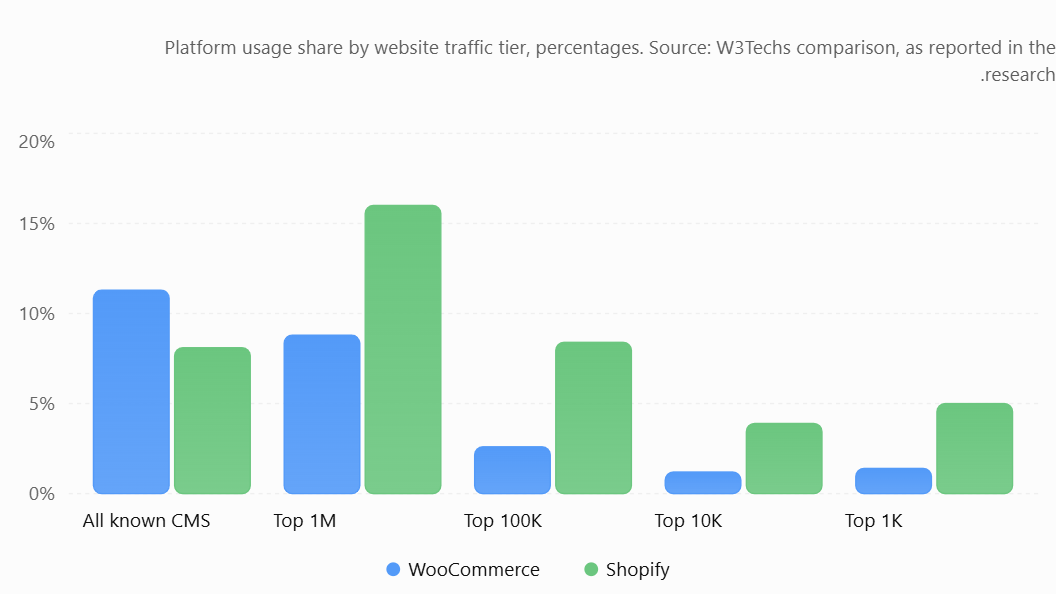
When looking specifically at websites using a known Content Management System (CMS) like WooCommerce, Shopify, and Wix, WooCommerce accounts for 11.3%, while Shopify accounts for 8.1%, according to W3Techs.
This gives WooCommerce a 3.2 percentage point lead over Shopify in this category, reinforcing its strong position in the CMS based website ecosystem.
3. Share of eCommerce Websites
This metric measures websites that have a detected eCommerce system. According to the latest W3Techs statistics, WooCommerce accounts for 46.5% of these websites, while Shopify accounts for 33.4%.
These figures show that WooCommerce continues to hold the leading position, while Shopify now powers approximately one-third of all websites using an eCommerce system.
4. Number of Live Stores: How Many Stores Actually Use Each Platform?
According to Store Leads, as of November 13, 2026, there are 4.30 million active stores using WooCommerce, compared to 3.30 million active stores using Shopify.
Who’s Actually #1? The Answer Depends on the Metric
Despite the differences in percentage across these metrics, they all point to the same conclusion: WooCommerce leads in overall adoption, with Shopify consistently ranking second.
WooCommerce leads in terms of overall adoption and the number of active stores, while Shopify takes the lead when it comes to the most highly trafficked websites.
Which Platform is Growing Faster?
This section answers one of the most important questions: Who’s actually gaining momentum in the market, and who’s losing market share?
-
The 12-Month Market Share Race
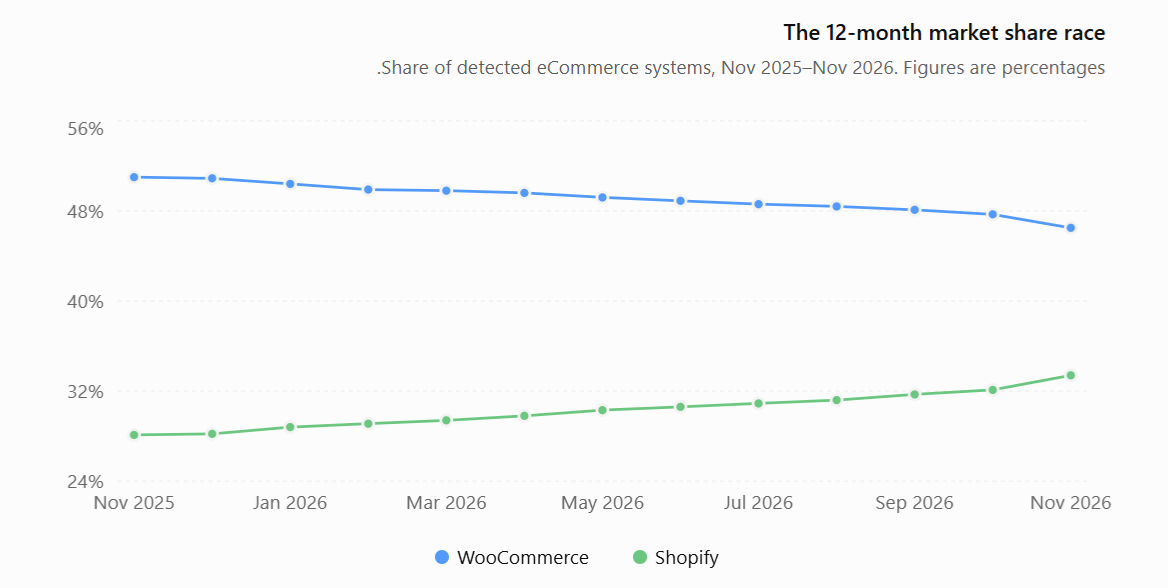
This chart shows that WooCommerce’s market share declined by 4.5 percentage points over approximately one year, while Shopify gained 5.3 percentage points over the same period. (W3Techs)
The gap between the two platforms narrowed from 22.9 percentage points to 13.1 percentage points.
This suggests that Shopify is not only growing but also steadily closing the gap with the market leader. If this trend continues, the difference between the two platforms could become significantly smaller in the coming years.
2. Live Store Growth: Shopify Is Pulling Ahead
According to Store Leads data, the number of stores registered on WooCommerce is declining, while Shopify continues to grow.
How the number of stores has changed
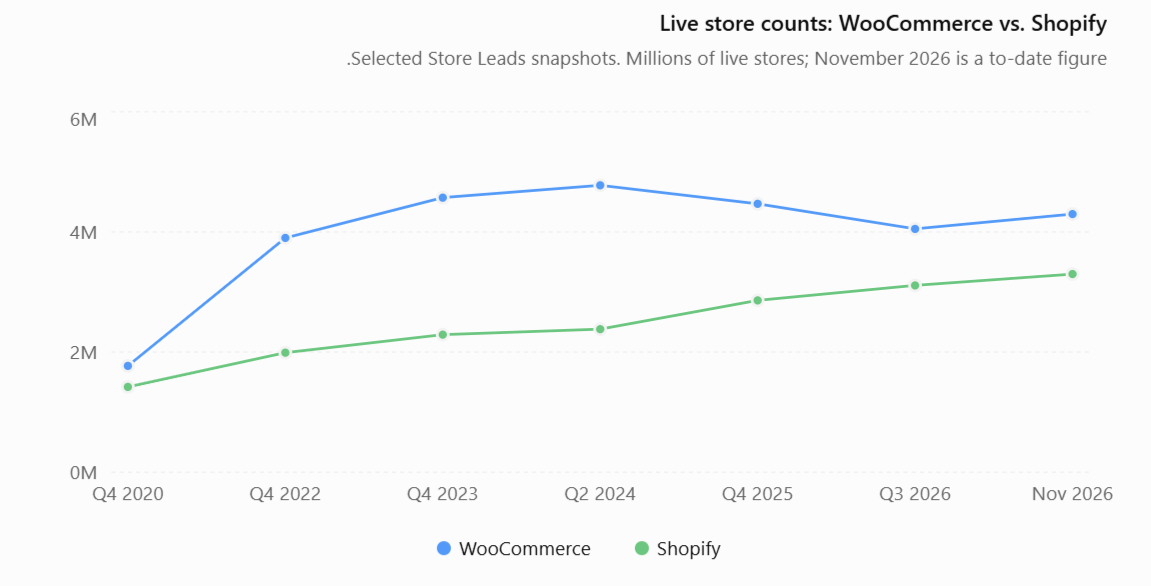
| Period | WooCommerce | Shopify |
|---|---|---|
| Q4 2020 | 1.77M | 1.42M |
| Q4 2022 | 3.90M | 1.99M |
| Q4 2023 | 4.57M | 2.29M |
| Q2 2024 | 4.78M | 2.38M |
| Q4 2025 | 4.47M | 2.86M |
| Q3 2026 | 4.05M | 3.11M |
| Nov 13, 2026 | 4.30M | 3.30M |
This points to three possible explanations:
- WooCommerce reached its peak in 2024.
- Shopify continued expanding.
- The gap between the two platforms is getting smaller.
3. Shopify’s Long-Term Growth
According to statistics and research, Shopify’s growth is not limited to recent years or just 2026. W3Techs data shows that the percentage of websites using Shopify increased from 0.4% in January 2016 to 5.5% in November 2026, meaning its share has grown to approximately 14 times its original level.
However, this growth has not been consistent every year. Its share reached 4.4% in 2022, then dropped to 3.8% in 2023 before resuming its upward trend. This indicates that Shopify’s growth is part of a longer-term trajectory rather than just a temporary spike.
What Could This Mean for the Future?
Based on the available data and analysis, we can explore several possible scenarios for how the market might evolve in the future:
| Scenario | Possible crossover |
|---|---|
| Store Leads: WooCommerce continues declining by 10% annually, Shopify grows by 15% | Late 2027 |
| Store Leads: WooCommerce remains flat, Shopify grows by 15% | Late 2028 |
| W3Techs: current market-share gap continues closing linearly | Around 2028 |
Note: These are not official forecasts published by either platform. They are estimates based on the assumption that current growth and decline rates continue. Actual results may vary if these rates change.
Where each platform is strongest
This section shifts the focus from comparing which platform has more stores to a more specific question: Where does each platform perform best, and which types of stores and markets are better suited to it? Reports show that each platform has its own strengths across different markets and business segments.
-
Traffic
WooCommerce has a wider presence across websites overall, while Shopify has a stronger presence among larger, high-traffic websites. This suggests that Shopify attracts a greater share of high-traffic stores, while WooCommerce dominates among smaller websites with lower traffic.
This highlights an important point: a platform’s strength is not determined solely by the number of stores using it, but also by the type and size of the websites it attracts.
2. Geography
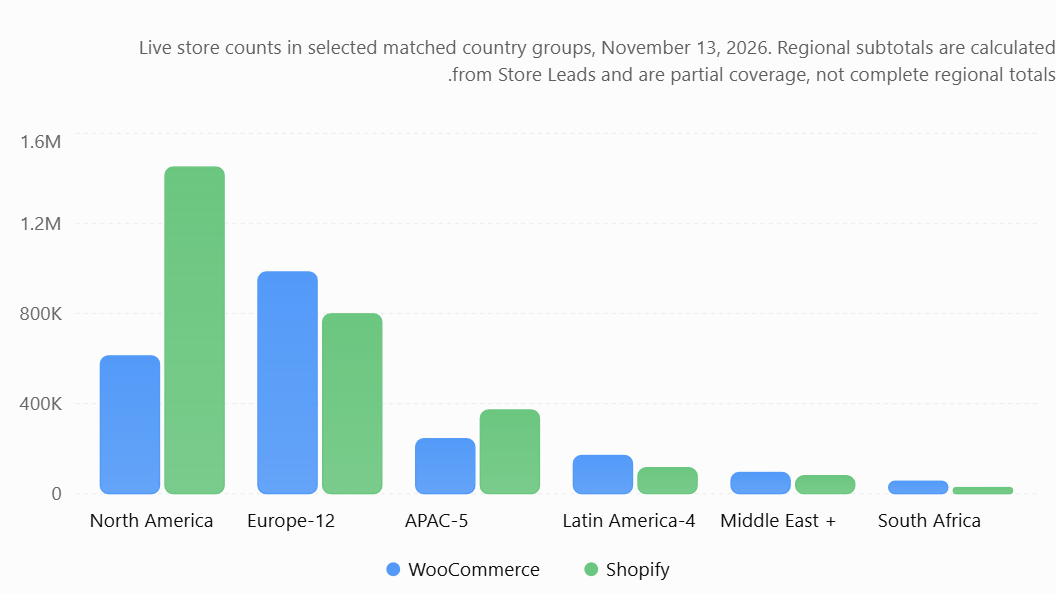
According to the latest statistics, Shopify leads in the United States, while WooCommerce has a stronger presence across many international markets, particularly continental Europe and parts of Latin America.
As of November 13, 2026, Shopify has approximately 2.44 times as many stores as WooCommerce in the United States, according to Store Leads.
3. Payments
Another important comparison is the availability and flexibility of payment methods on each platform.
WooCommerce allows store owners to use multiple third-party payment gateways rather than relying solely on WooCommerce. Shopify, on the other hand, offers its own built-in payment solution, Shopify Payments, which is integrated directly into the platform.
However, Shopify Payments is only available in supported countries. If a merchant operates in a country where it is not supported, they must use one of the third-party payment gateways approved by Shopify.
This limitation can reduce the available payment options for some merchants, making WooCommerce a more attractive option for businesses that need greater flexibility in choosing their payment providers.
4. Industry and Store Type
According to the latest Store Leads statistics, each platform has a stronger presence in different, segmeents and industries.
| Industry | WooCommerce | Shopify | |
|---|---|---|---|
| Apparel | 7.9% | 27.1% | Shopify |
| Home & Garden | 11.3% | 12.8% | Shopify |
| Beauty & Fitness | 5.4% | 10.8% | Shopify |
| Food & Drink | 7.1% | 6.7% | WooCommerce |
| Health | 5.5% | 4.4% | WooCommerce |
| Business & Industrial | 8.1% | 2.2% | WooCommerce |
According to Store Leads, Apparel is the largest industry category on Shopify, accounting for 27.1% of its stores, compared to 7.9% on WooCommerce. Shopify also has a higher share of stores in Beauty & Fitness and Home & Garden.
WooCommerce, meanwhile, has a stronger relative presence in Business & Industrial, where 8.1% of its stores operate, compared to approximately 2.2% of Shopify stores. It also has a slightly higher share in Food & Drink and Health.
However, these figures reflect the distribution of stores on each platform, rather than their overall market share within each industry. They also do not necessarily indicate which platform is better suited to a particular type of business.
Are Store Owners Switching from WooCommerce to Shopify?
Are store owners actually switching from WooCommerce to Shopify, or is Shopify growing faster through new stores and different platform choices?
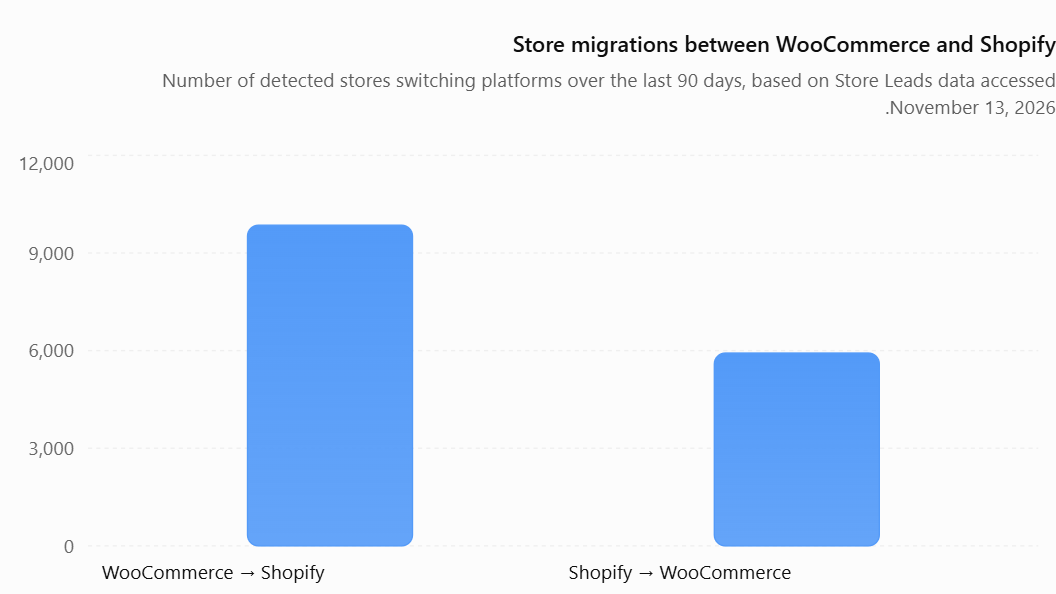
According to Store Leads data for the 90 days ending November 13, 2026, 9,855 stores migrated from WooCommerce to Shopify, while 5,926 stores moved from Shopify to WooCommerce. This resulted in a net migration of 3,929 stores to Shopify, indicating that more stores switched from WooCommerce to Shopify than the other way around during this period.
Another study published by TechnologyChecker on September 23, 2026, tracked the following platform migrations over 90 days:
- 4,715 domains moved from WooCommerce to Shopify.
-
1,886 domains moved from Shopify to WooCommerce.
This represents a migration ratio of approximately 2.5 to 1 in Shopify’s favor, meaning that for every domain moving from Shopify to WooCommerce, roughly 2.5 domains moved in the opposite direction.
Is switching from WooCommerce to Shopify easy? Not necessarily. Shopify’s official migration guide explains that the process may involve transferring products, customers, previous orders, reviews, blog posts, and pages. Some data may also require additional steps or third-party tools.
However, we can identify several possible reasons why owners might choose to make this switch:
- Reduced Technical Responsibilities: Shopify is a hosted platform, while WooCommerce relies on WordPress, hosting, plugins, and updates that store owners or their teams need to manage themselves.
- Managing Commerce from One Place: Shopify brings together the online store, hosting, and payment tools. It also supports selling across multiple channels, including in-person sales through its POS system.
- Less Reliance on External Configurations and Plugins: Some store owners may prefer a more integrated system rather than having to manage multiple plugins and separate third-party services.
What’s Next for WooCommerce and Shopify?
The future of eCommerce will not be limited to website design, payment methods, and other traditional features. Instead, it will increasingly revolve around artificial intelligence and how it can be integrated into online commerce to make the experience easier, smarter, and more efficient for both merchants and customers.
But how are WooCommerce and Shopify preparing for this shift?
One of the most notable developments being explored is Agentic Commerce, a new model of eCommerce in which AI agents can help shoppers discover products, compare available options, and potentially complete purchases on their behalf.
Both Shopify and WooCommerce are preparing for this shift, but each platform is taking a different approach.
Shopify is working on building channels that connect merchants with AI-powered shopping assistants. One of its most notable initiatives is the development of the Universal Commerce Protocol (UCP) in collaboration with Google, which aims to make it easier for AI agents to interact with eCommerce systems
WooCommerce, on the other hand, is expanding its AI capabilities through technologies such as the WordPress Abilities API and the Model Context Protocol (MCP). These technologies allow AI assistants to interact with store data and perform various tasks, such as searching for products, creating new products, and managing orders.
Shopify is increasingly moving toward building a unified commerce platform that brings together online stores, in-person retail, payment processing, and business management tools. Its goal is to provide an integrated infrastructure that allows merchants to manage multiple aspects of their businesses from a single platform.
WooCommerce, on the other hand, has a future that is closely tied to the continued development of the WordPress ecosystem. Its open-source model gives merchants and developers greater control over their choice of hosting providers, payment services, third-party integrations, and store customization to meet their specific needs.
However, its main challenge will be making these capabilities easier to use without sacrificing the flexibility that makes it a preferred choice for many merchants and service providers.
Conclusion: Which Platform Is Leading in 2026?
To sum up, WooCommerce remains the larger platform in terms of overall adoption and the number of stores, holding a 46.5% share of websites using known eCommerce technologies compared to 33.4% for Shopify.
However, Shopify leads in growth, commercial momentum, revenue, and future trends; we cannot say one platform is superior in every aspect, as each has its own strengths.
As Shopify continues to grow, the gap between the two platforms is narrowing at a faster pace, while WooCommerce’s market share is declining. Shopify is also gaining an advantage in terms of gross sales volume and revenue, particularly through its investments in AI and unified commerce.
On the other hand, WooCommerce continues to maintain its strength in several areas, especially its open-source model, which gives store owners the flexibility and freedom to control their hosting, payment gateways, and other aspects of their stores.
However, if current growth trends continue at this pace, Shopify could potentially surpass WooCommerce in the number of stores over the coming years.
Ultimately, if the question is which platform has the wider adoption in 2026, the answer is still WooCommerce. But if the question is which platform is growing faster and gaining greater commercial momentum, Shopify is currently ahead.
Frequently Asked Questions
1. Is WooCommerce bigger than Shopify in 2026?
Yes. WooCommerce still leads Shopify in overall store count and eCommerce market share. As of November 2026, W3Techs reports that WooCommerce is used by 46.5% of websites with a detected eCommerce system, compared to 33.4% for Shopify. However, Shopify is growing faster and continues to narrow the gap.
2. Is Shopify growing faster than WooCommerce?
Yes. According to W3Techs, Shopify’s share of websites using detected eCommerce technologies increased from 28.1% in November 2025 to 33.4% in November 2026. WooCommerce’s share declined from 51.0% to 46.5% over the same period. Store Leads also reported 15% year-over-year growth for Shopify and a 10% decline for WooCommerce in Q3 2026.
3. Are store owners switching from WooCommerce to Shopify?
Yes. Store Leads detected 9,855 stores moving from WooCommerce to Shopify over a 90-day period ending November 13, 2026, compared to 5,926 moving in the opposite direction. This represents a net migration of 3,929 stores toward Shopify. However, migration is only one factor behind Shopify’s growth; new store launches and migrations from other platforms also contribute.
4. Why are merchants switching from WooCommerce to Shopify?
Some merchants may prefer Shopify because it offers managed hosting, integrated commerce tools, built-in payment options in supported countries, and centralized store management. WooCommerce offers more control over hosting, customization, and payment providers, but merchants are generally responsible for managing more parts of their store setup. The right choice depends on each business’s technical resources and priorities.
5. Which platform has more stores in the United States?
Shopify has a significantly stronger presence in the US. Store Leads data from November 2026 shows that Shopify has approximately 2.4 times as many detected stores in the United States as WooCommerce. WooCommerce, however, has a stronger presence in many continental European and other international markets.
6. Which platform is better for large product catalogs?
Both platforms can support large product catalogs, but Store Leads data shows a stronger representation of very large catalogs among WooCommerce stores. It detected 45,863 WooCommerce stores with 25,000–99,999 products, compared to 12,617 Shopify stores. These figures describe platform usage, not a technical limitation or proof that one platform performs better.
7. Does WooCommerce generate more sales than Shopify?
There is no reliable public data to establish which platform generates more total merchant sales. Shopify reported $378.4 billion in GMV for 2025, but WooCommerce does not publish an equivalent figure covering all stores using its platform. Therefore, a direct comparison is not currently possible.
8. How much revenue does Shopify make compared to WooCommerce?
Shopify reported approximately $11.6 billion in revenue in 2025. WooCommerce does not report separate corporate revenue because it is an open-source platform within the wider WordPress and Automattic ecosystem. Shopify’s revenue should not be compared directly with WooCommerce merchant sales or GMV.
9. Is WooCommerce free compared to Shopify?
WooCommerce’s core plugin is free and open-source, but running a store may involve hosting, domain registration, paid extensions, maintenance, and development costs. Shopify uses paid subscription plans, with additional costs potentially coming from apps, payment processing, and other services. The total cost depends on the store’s size and requirements.
10. What is the future of WooCommerce and Shopify?
Both platforms are investing in the next generation of eCommerce, particularly AI-powered shopping and store management. Shopify is expanding its integrated commerce ecosystem and connections to AI shopping channels, while WooCommerce is developing open integrations that allow AI tools to interact with stores. There are currently no reliable forecasts showing which platform will hold a larger market share by 2030.
Sources
W3Techs – WooCommerce vs Shopify Usage Statistics
W3Techs – E-commerce Market Share Trends
Store Leads – The State of WooCommerce in 2026
Store Leads – The State of Shopify in 2026
W3Techs – Historical E-commerce Market Share
Store Leads – WooCommerce Growth & Migration
Store Leads – Shopify Growth & Migration