WooCommerce Statistics 2025: Market Share, Growth & Global Adoption


Quick answer: WooCommerce powers about 4.15 million live online stores in 2026 and remains one of the most widely used eCommerce platforms, especially on WordPress. The sections below cover its market share, revenue, the 1,200+ official extensions, where stores are located and where growth is heading, with sources listed at the end.
Today, simply having an online store is not enough; it goes beyond that to understand the platform you are using and its reach to the market.
The harder question is whether that platform is actually still going where you need it to go, and the only way to answer is to look at the numbers behind it, not the pitch.
WooCommerce stands out as one of the most flexible and easiest digital platforms, providing you with seamless access to your audience. However, having a flexible and user-friendly platform is not enough for success.
Real growth lies in understanding the statistics of this platform. So, understanding WooCommerce’s sales volume, adoption, and available plugins directly reflects your growth, business strategy, expansion, and the most effective way to invest your time and resources in online selling.
For that, this article will show you the latest WooCommerce statistics, discuss what they mean for the platform’s growth, and show you how these statistics and insights can shape your store strategy and growth.
Let’s get started!
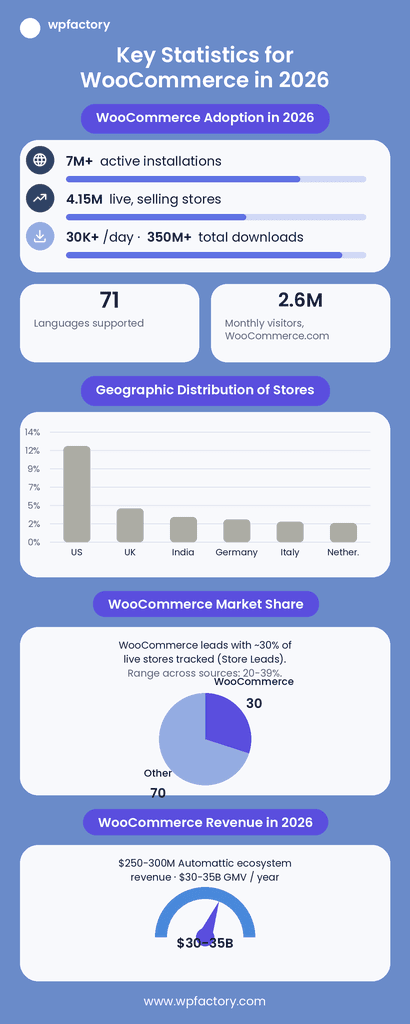
Key WooCommerce Statistics in 2026
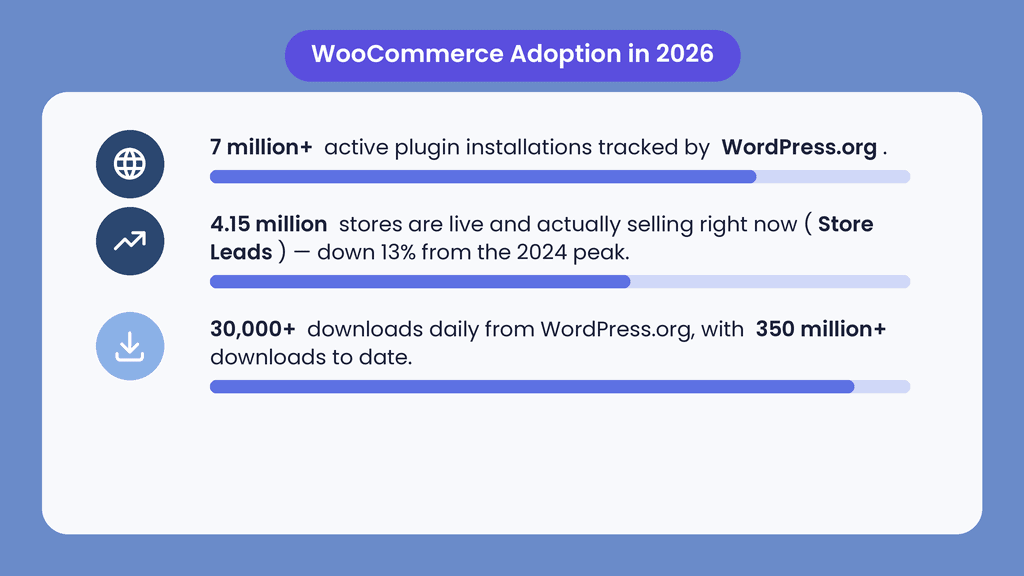
WooCommerce Adoption in 2026: 4.15 million Live Stores, and a Market That’s Matured
As of May 2026. Store leads count 4,151,703 live WooCommerce stores. BuiltWith, which casts a much wider net that includes inactive and in-development sites, puts total WooCommerce detections at 6 million.
WordPress.org lists WooCommerce at 7+million active plugin installations, though that figure includes staging sites, test environments, and stores that technically have the plugin active without actually selling anything.
This impressive number shows us the remarkable growth and widespread adoption of WooCommerce, reflecting users’ trust in this platform for its flexibility, vast plugin ecosystem, and deep integration with WordPress, which make it a preferred choice for business owners.
And on the other side, we shouldn’t forget that the gap is still there, in numbers, from one place to another. Each source counts a different thing. Store Leads is the closest read on “stores that are actually open for business,” so it’s the number we’d lean on if you only have room for one.
One of the most important statistics that most articles overlook is that the number of WooCommerce stores is no longer increasing at the same previous pace. This means that WooCommerce peaked at 4.78 million active stores in the second quarter of 2024, and since then it has started to decline, with the number today about 13% lower than that peak, and around 8% lower than the same period last year, according to Store Leads.
And this doesn’t mean that the platform is facing a problem; rather, it shows that the platform has moved from rapid growth to a large and mature market meant for replacement and improvement. This means the platform gains and loses stores. Over the past three months, WooCommerce attracted around 15,171 stores that moved from other platforms like Shopify, and at the same time, it lost about 22,372 stores to its competitors.
Infographic showing WooCommerce adoption, store distribution, and revenue stats for 2026.
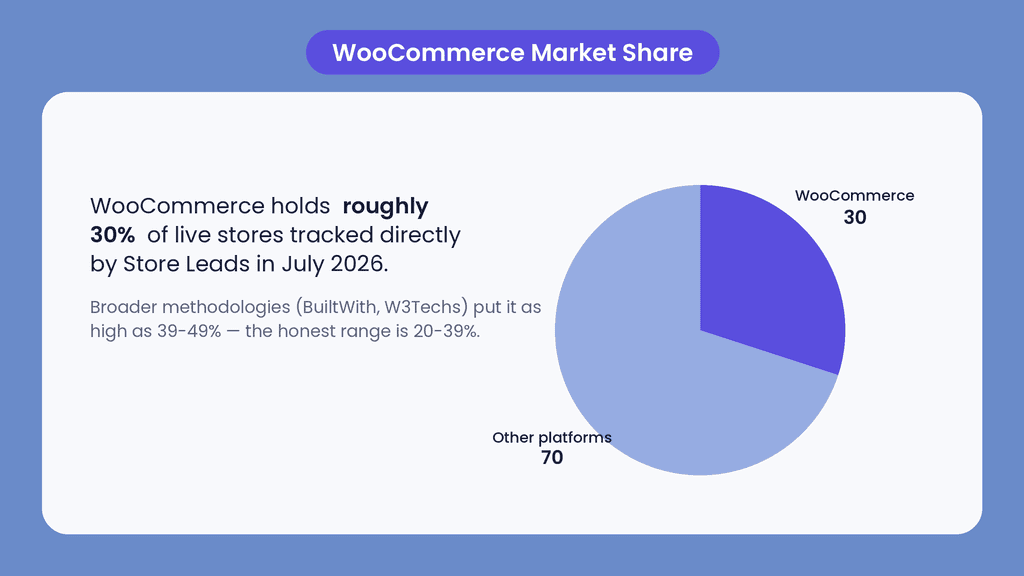
WooCommerce Market Share: Leading the eCommerce industry
According to the Store Leads report, which measures the number of active and live stores, WooCommerce has about a 30% share. Other sources, like BuiltWith, which examines the entire open web instead of indexing specific stores, estimate WooCommerce’s share at up to 39%. Meanwhile, W3Techs, which only measures sites that have their eCommerce platform identified, puts it closer to 49%.
What hasn’t changed: by store count, WooCommerce still leads Shopify’s ~2.9 million stores in the same Store Leads dataset. What has changed is that this is a live-store lead, not necessarily a growth lead; Shopify’s merchant count is currently growing somewhat faster, even with WooCommerce still running more stores in absolute terms.
This massive market share is due to the flexibility of this platform and its open source, which makes it easy for users to build and customize their stores as they want, which matches their identity, in addition to its seamless integration with other tools and plugins.
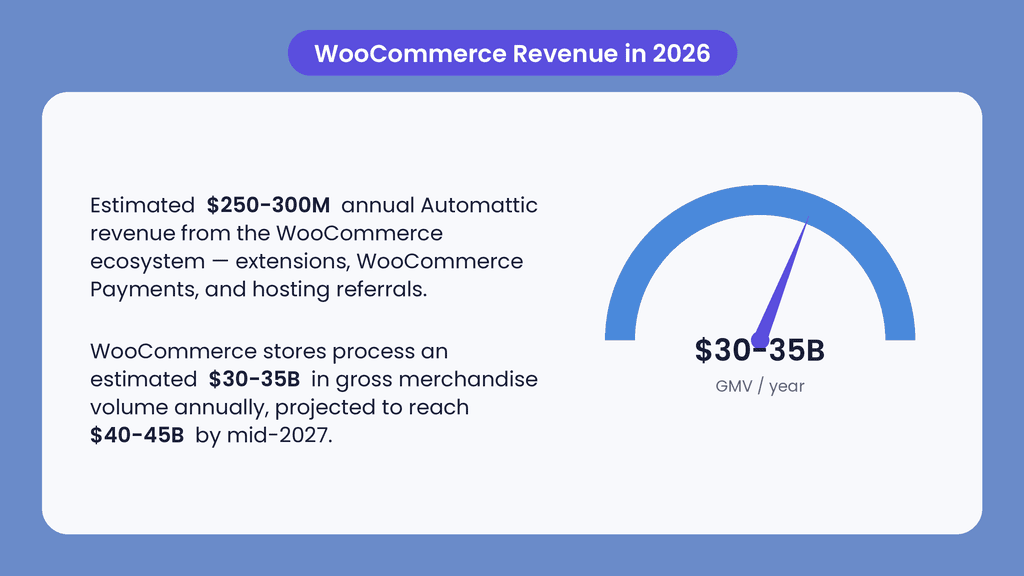
WooCommerce Revenue in 2026: A Look Behind Numbers
WooCommerce’s revenue number hasn’t been published clearly or uniformly. Still, current estimates put its share of the entire WooCommerce ecosystem, including plugins, WooCommerce Payments, and hosting referrals, at around $250–300 million a year.
The stores themselves collectively process an estimated $30–35 billion in gross merchandise volume a year, a figure that’s held roughly steady rather than climbing sharply, which tracks with the adoption plateau above. Some projections put GMV crossing $40–45 billion by mid-2027; treat that as a projection, not a confirmed trend.
For store owners, this means:
- Huge Potential Market: Millions of customers visit WooCommerce daily, making it a huge market full of opportunities for both large and small stores.
- Huge Plugins System: As we mentioned previously, WooCommerce generates around $28 million from official plugins; this means store owners can leverage these tools and plugins to enhance their stores, user experience, and boost sales. For example, you can use tools like upselling-cross-selling plugins to generate more sales.
WooCommerce Extensions: Over 1,200 Official WooCommerce Extensions Available
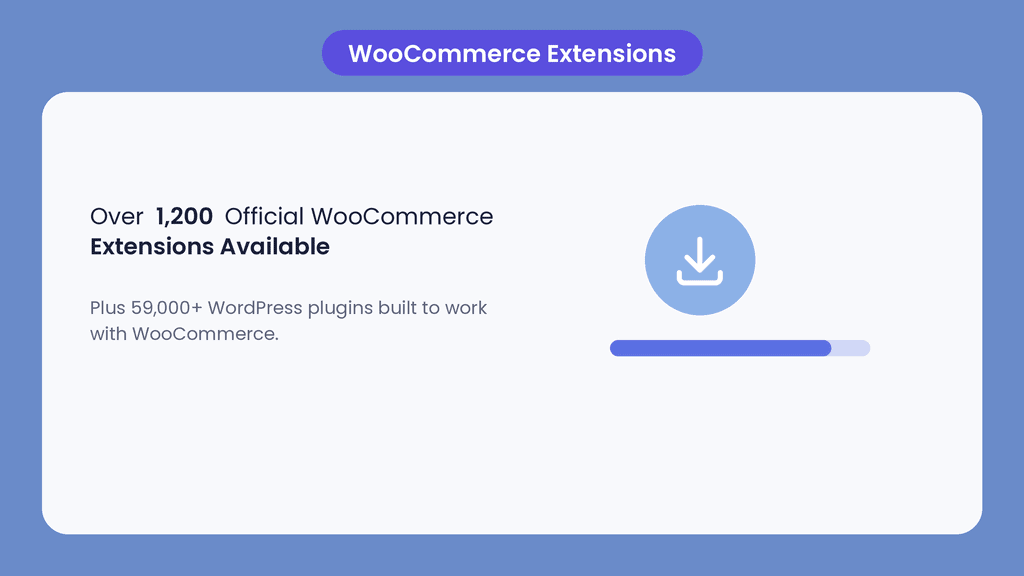
WooCommerce statistics show that WooCommerce offers over 1,200 official extensions. This vast ecosystem of plugins gives store owners the tools they want to customize their online store, from inventory management and marketing to payment gateways and shipping solutions.
Most Popular WooCommerce Extensions:
- WooPayments
- Google for WooCommerce
- PayPal Braintree for WooCommerce
- AutomateWoo
- WooCommerce Bookings
And according to WP Experts, around 297,641 WooCommerce extensions are downloaded daily. This shows us the popularity and widespread of this platform.
Extensions with real, verifiable adoption right now (Store Leads, July 2026):
- WooPayments: 436,895 stores (10.5% of all WooCommerce stores)
- Mailchimp for WooCommerce: 209,585 stores (5.0%)
- WooCommerce Subscriptions: 41,188 stores
- PayPal Payments: 33,005 stores
- WooCommerce Bookings: 13,518 stores
At WPFactory, we contribute to this rich system with our own WooCommerce plugins. WPFactory offers a mix of free and premium plugins that cover diverse aspects, from store management, marketing, and promotion to store customization.
WooCommerce Distribution: Geographic Distribution of Stores
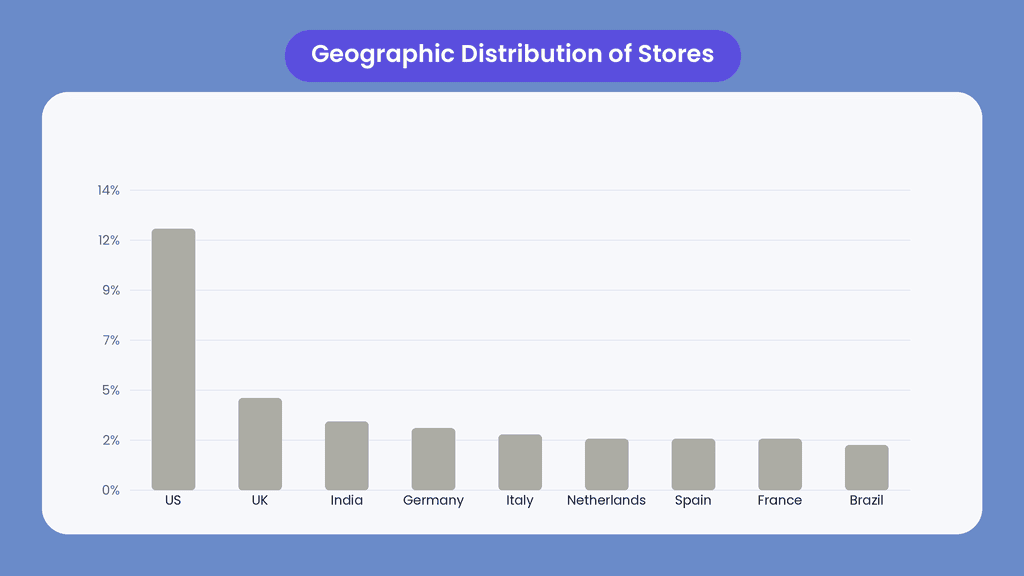
As we all know, WooCommerce is widely used in countries all over the world. However, some statistics highlight the countries where WooCommerce is most commonly used.
According to BuiltWith statistics, the top countries for 2025:
| Country/Region | Active WooCommerce Stores | Annual Growth Rate |
| United States | 507,930 | 12.2% |
| United Kingdom | 178,147 | 4.3% |
| Europe (EU total) | 1,000,000+ | 6% |
| Germany | 120,744 | 2.9% |
| India | 130,952 | 3.2% |
| Italy | 108,294 | 2.6% |
| Spain | 98,887 | 2.4% |
The United States ranks first, with over 2 million active WooCommerce stores.
WooCommerce Growth: Future Trends and Growth Predictions for WooCommerce 2027
Older forecasts, including the ones we cited here in 2025, projected WooCommerce climbing toward 7+ million live stores by 2028. That hasn’t held up. The platform peaked in 2024 and has since settled into the plateau described above. Here’s a more accurate read on where it’s headed:
- Store count: likely to stabilize in the 4–4.5 million range rather than resume rapid growth, barring a major shift (deeper AI-native tooling, or a headless/composable push that makes WooCommerce newly attractive to larger merchants).
- Market share: expected to hold in the 30–35% band most sources converge on, rather than drifting toward either end of the wider 20–39% range.
- GMV: projected toward $40–45 billion by mid-2027, growing modestly even without store-count growth, a sign that average revenue per store, not the number of stores, is what’s actually climbing.
- Geographic mix: continued diversification into Southern Europe and Latin America, alongside the already-large US and UK base.
None of this suggests that WooCommerce has lost its importance; rather, it indicates that the platform’s rapid growth has slowed down and it has reached a mature stage.
Final Thoughts
There are 4.15 million live stores on WooCommerce. What’s even more impressive is that WooCommerce still leads in flexibility and cost-efficiency, even after its growth has stabilized.
This proves that a platform doesn’t necessarily have to be in huge, continuous growth to be the best choice for users.
Whether you’re running a big project or a small one, WooCommerce is the best choice when it comes to open-source flexibility, cost, a massive plugin ecosystem, and full ownership of your store’s data, making it the safest platform in 2026.
References:
- Store Leads: The State of WooCommerce in 2026
- Store Leads: The State of Ecommerce in 2026
- WordPress.org: WooCommerce Plugin
- Colorlib: WooCommerce Statistics 2026
- Red Stag Fulfillment: WooCommerce Market Share


