How to Restrict Payment Methods in WooCommerce (By Country, Role, Cart Total & More)

Quick answer: WooCommerce only lets you turn payment gateways on or off for everyone. To show or hide a gateway by country, user role, cart total or product, use conditional payment gateway rules, gateways by customer location or gateways per product. The scenarios below show which rule to use for each case.
You’ve set up your WooCommerce store, installed a handful of payment gateways, and now every customer sees every option.. regardless of where they live, how much they’re spending, or who they are.
A wholesale buyer sees the same checkout as a first-time visitor. A customer in Germany sees a payment method that doesn’t even work in their country. Someone placing a $2,000 order can still choose Cash on Delivery.
This is exactly why store owners need to restrict payment methods in WooCommerce. Not to make things harder for customers.. but to make checkout smarter, safer, and more relevant for every single buyer.
In this guide, you’ll learn how to apply conditional payment rules across six key dimensions: product, product category, cart total, user role, shipping method, and country.
Each section includes a real store scenario you can adapt directly to your own setup.
Quick Answer: How to Restrict Payment Methods in WooCommerce
WooCommerce doesn’t offer built-in conditional payment rules. To restrict payment methods by country, user role, cart total, product, or shipping method, you need a plugin like Conditional Payment Methods for WooCommerce.
- By Product → Hide or show specific gateways when certain products are in the cart
- By Category → Apply payment rules across an entire product category
- By Cart Total → Block COD or PayPal above/below a set order value
- By User Role → Offer bank transfer only to wholesale customers
- By Shipping Method → Restrict COD to local pickup orders only
- By Country → Show region-specific gateways to matching customers only
Keep reading for step-by-step instructions, real store examples, and an interactive rule builder to plan your own restrictions.
Note: This guide focuses on restricting payment methods by role, cart total, country, shipping method, and category. If you’re specifically looking to disable a payment method for a single product, see our dedicated guide: How to Disable a Payment Method for a Specific Product in WooCommerce.
Why WooCommerce’s Default Payment Settings Aren’t Enough
Out of the box, WooCommerce lets you enable or disable payment gateways globally. That’s it. You can’t say “show PayPal only for orders under £100” or “hide Cash on Delivery for customers outside your city.” Every customer sees every active gateway.. which creates real problems:
- Customers in countries where a gateway doesn’t work still see it at checkout.. and get confused when it fails
- High-value orders can be placed via COD, leaving you exposed to non-payment risk
- Wholesale buyers see the same checkout as retail customers, even if you’ve negotiated different payment terms
- You have no way to enforce payment by bank transfer for large custom orders
The solution is conditional payment rules.. logic that shows or hides specific gateways based on what’s in the cart, who the customer is, and where they’re located.
Real Store Scenarios: When Payment Restrictions Actually Matter
Before diving into the setup, here are five concrete situations that store owners deal with regularly. These aren’t hypothetical.. they reflect the exact queries that bring people to this topic.
-
Scenario 1: No Cash on Delivery for Digital Products
You sell a mix of physical and digital products. COD makes sense for a physical item being shipped to a local address.. but it makes no sense at all for a PDF download or a software license.
If a customer orders a digital product via COD, what exactly are you collecting payment for at the door?
Rule needed: Hide Cash on Delivery whenever a digital product is in the cart.
-
Scenario 2: PayPal Only Available for Orders Under £100
PayPal charges a percentage fee on every transaction. For a £20 order, that’s manageable. For a £600 order, you’re giving away a meaningful slice of your margin.
You want PayPal available for small purchases.. it’s familiar and trusted, but for larger orders, you’d rather steer customers toward bank transfer.
Rule needed: Disable PayPal when cart total exceeds £100. Show bank transfer as the primary option for high-value orders.
-
Scenario 3: Bank Transfer Only for Wholesale Customers
Your wholesale buyers place large orders on net-30 terms. They pay by bank transfer.. always. But you don’t want regular retail customers to see the bank transfer option, because it creates support overhead when someone tries to use it for a £15 purchase and then emails asking where to send the money.
Rule needed: Show bank transfer exclusively to users with the “Wholesale Customer” role.
-
Scenario 4: Hide Klarna in Non-EU Countries
Klarna operates in specific markets. If a customer in the United States or Australia sees Klarna at checkout and clicks it, they’ll hit an error.. or worse, complete a failed order.
That’s a bad experience that reflects poorly on your store, not on Klarna.
Rule needed: Hide Klarna for customers outside supported EU/UK countries.
-
Scenario 5: COD Only Available for Local Pickup Orders
You offer local pickup from your warehouse, and COD is perfectly reasonable for those customers.
But for orders being shipped 500 miles away, accepting COD is a financial risk. If the customer refuses delivery, you’re out the shipping cost and the product.
Rule needed: Restrict Cash on Delivery to orders using the “Local Pickup” shipping method only.
How to Restrict Payment Methods in WooCommerce? The Plugin You Need
None of the above rules are possible with WooCommerce’s native settings. You need a plugin that adds conditional logic to your payment gateway display.
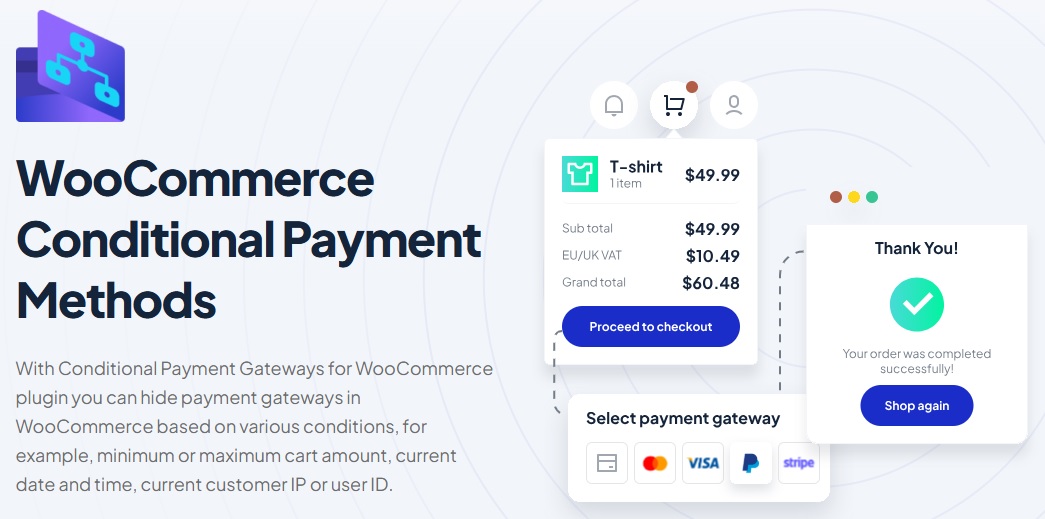
Conditional Payment Methods for WooCommerce by WPFactory is built exactly for this. It lets you create include/exclude rules for any payment gateway based on a wide range of conditions.. no code required.
🔌 WPFactory: Conditional Payment Methods for WooCommerce
Set up payment restrictions by country, user role, cart total, product, category, shipping method, and more — all from a simple settings panel. No coding needed.
Installation in 3 Steps
1. Download the plugin ZIP from WPFactory
2. In your WordPress dashboard, go to Plugins → Add New → Upload Plugin, select the ZIP, and click Install Now → Activate

3. Enable the Plugin
After activation, follow these steps to turn on the plugin:
- In your WordPress dashboard, go to WooCommerce > Settings.
- Click on the Conditional Payment Gateways tab.
- Find the option Enable Plugin and check the box.
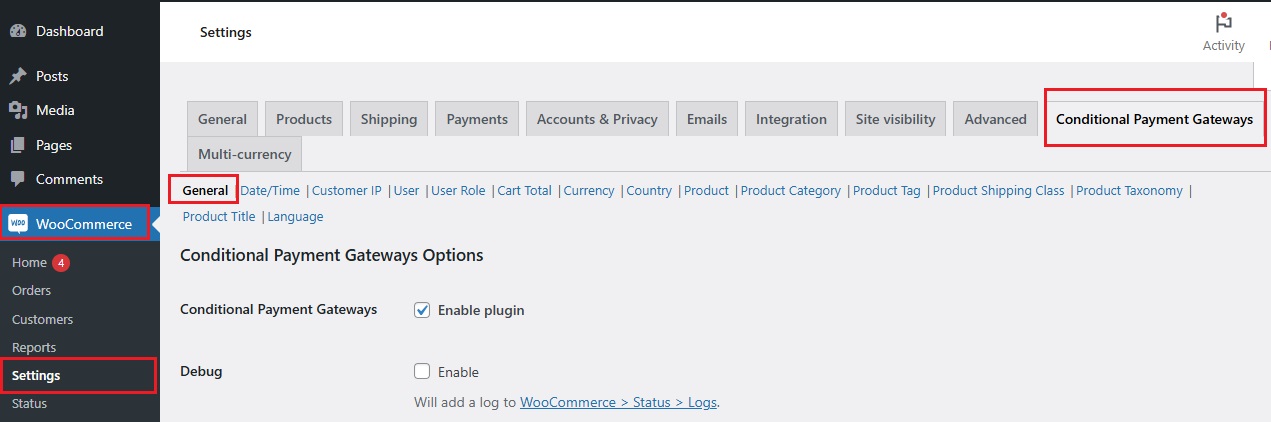
That’s it! The plugin is now running, and you can start setting up payment restrictions.
4. Adjust the Settings
Now it’s time to customize how payment methods will work in your store.
- Stay on the Conditional Payment Gateways tab.
- Scroll down to find Available Conditions, this is where you’ll set the rules.
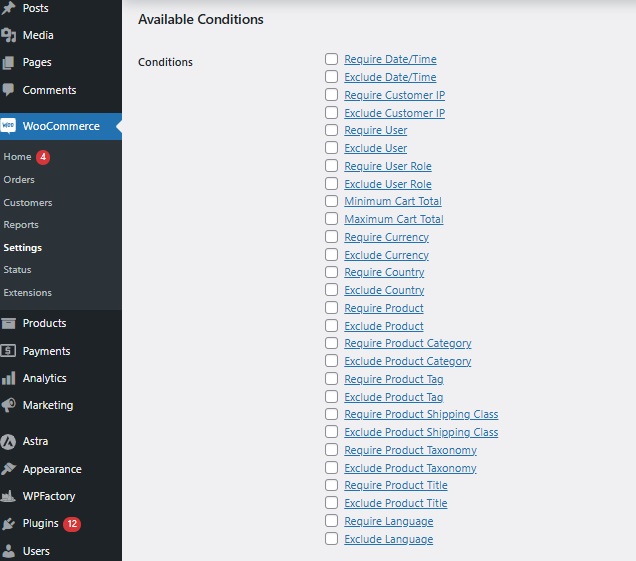
Here are some of the options you can configure:
-
- Require Date/Time → Only allow certain payment methods during specific hours or days (great for flash sales or limited-time offers).
- Exclude Date/Time → Disable certain payment methods on specific dates (helpful for payment gateways that aren’t available on weekends or holidays).
- Require Customer IP → Only allow certain payment methods for customers from specific IP addresses (useful for private sales or internal orders).
- Exclude Customer IP → Block payment methods for certain IPs (can help prevent fraud from suspicious locations).
- Minimum Cart Total → Allow certain payment methods only if the cart total is above a set amount (e.g., allow bank transfer only for orders over $500).
- Maximum Cart Total → Disable certain payment methods if the order exceeds a certain value (e.g., disable cash on delivery for high-value purchases).
- Require Product → Show a specific payment method only when certain products are in the cart (e.g., allow PayPal only for digital products).
- Exclude Product → Hide payment methods for certain products (e.g., disable buy now, pay later for expensive items).
And more.
Restrict Payment Methods by Product
Product-level restrictions are the most granular type of rule. You’re telling WooCommerce: “If this specific product is in the cart, change what payment options are available.”
This is particularly useful when you have a mixed catalog.. physical goods alongside digital downloads, or standard products alongside custom-made items with special payment requirements.
How to set it up:
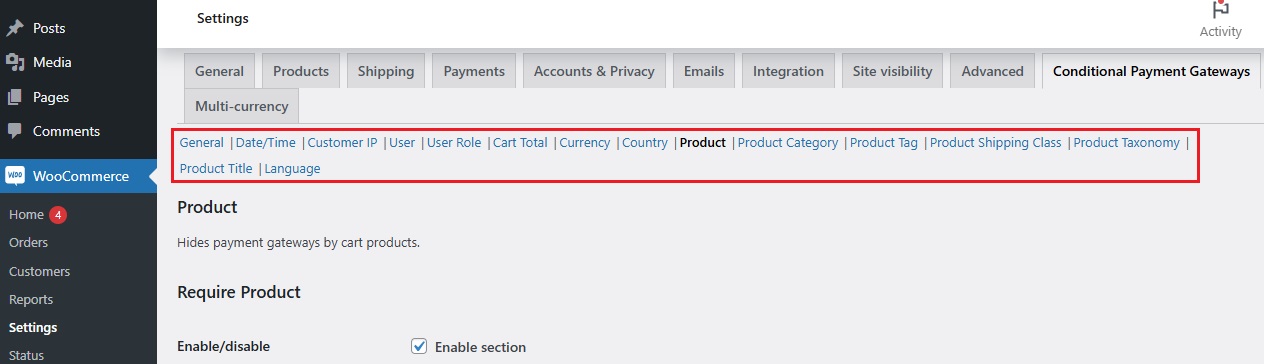
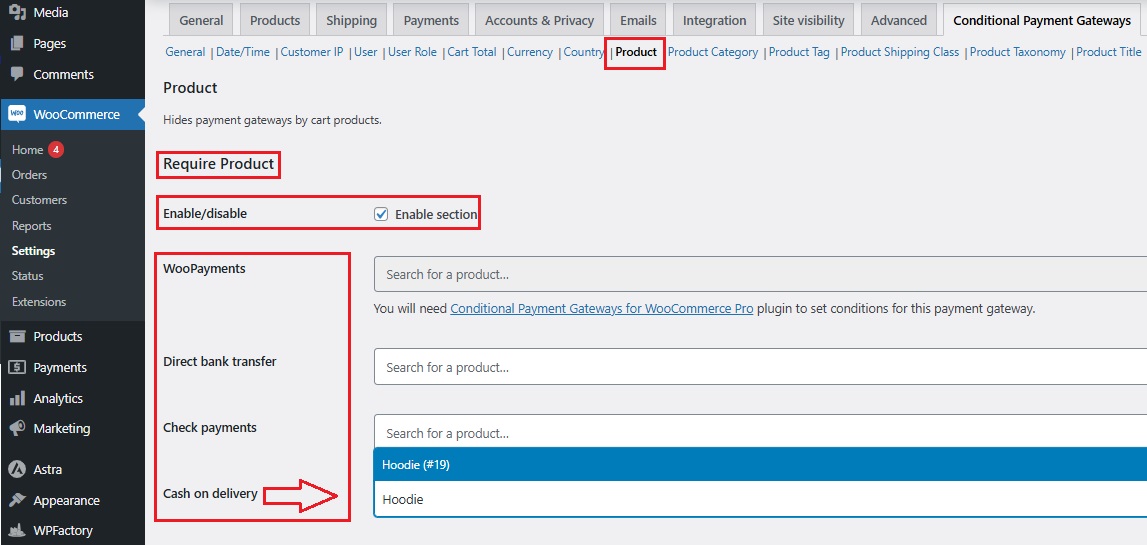
- Go to WooCommerce → Settings → Conditional Payment Gateways
- Click on the Product tab
- Under Require Product: select the payment gateway and enter the product name(s) that must be in the cart for it to appear
- Under Exclude Product: select the gateway and enter the product(s) that should cause it to disappear
- Click Save Changes
Example in practice:
You sell phone cases (£15) and laptops (£1,200). COD is enabled for phone cases only. When a customer adds a laptop to their cart, COD disappears automatically. They must pay by card or bank transfer.
For a full deep-dive on product-level rules, see: How to Disable a Payment Method for a Specific Product in WooCommerce.
Restrict Payment Methods by Product Category
If you have dozens or hundreds of products, setting rules product-by-product becomes unmanageable. Category-level restrictions let you apply a single rule to an entire group of products at once.
This is the right approach when your payment logic follows your catalog structure.. for example, all furniture requires bank transfer, all digital products exclude COD, all perishable goods require upfront card payment.
How to set it up:
- Go to the Product Category tab in the plugin settings
- Under Require Category: choose which gateway appears only when products from that category are in the cart
- Under Exclude Category: choose which gateway disappears when that category is present
- Save Changes and test with a product from that category
Example in practice:
Your “Custom Furniture” category contains made-to-order items. These require a 50% deposit via bank transfer.. COD and PayPal are excluded for this entire category. Customers who add any furniture item to their cart see only bank transfer at checkout.
Payment Restriction Methods: Quick Comparison
Not sure which type of restriction fits your situation? This table maps common store problems to the right rule type:
| Restriction Type | Best For | Real Example | Priority |
|---|---|---|---|
| By Product | Mixed catalogs with specific items needing special rules | No COD for digital downloads | High |
| By Category | Large catalogs where rules follow product type | Bank transfer only for all furniture | High |
| By Cart Total | Fee optimization and fraud prevention on large orders | Disable PayPal above £100 | High |
| By User Role | B2B/wholesale stores with different payment terms | Bank transfer for wholesale only | High |
| By Shipping Method | Stores offering both local pickup and delivery | COD only for local pickup | Medium |
| By Country | International stores with region-specific gateways | Hide Klarna outside EU/UK | High (if selling internationally) |
Restrict Payment Methods by Cart Total
Cart total restrictions are one of the most commercially valuable rules you can set up.
They let you protect your margins on large orders and reduce fraud risk.. without affecting the checkout experience for smaller purchases.
Two types of rules apply here:
- Minimum cart total: A gateway only appears when the cart reaches a certain value (e.g., bank transfer only for orders over $500)
- Maximum cart total: A gateway is hidden once the cart exceeds a certain value (e.g., no COD for orders above $300)
How to set it up:
- Go to the Cart Total tab in the plugin settings
- Set a Minimum Cart Total for gateways you want to unlock at higher order values
- Set a Maximum Cart Total for gateways you want to block above a threshold
- Save Changes
Example in practice:
For orders under £100, customers see PayPal, card, and COD. Once the cart hits £100, PayPal disappears (too expensive in fees). Once it hits £300, COD disappears too (too risky). For orders over £300, only card and bank transfer are available.
Restrict Payment Methods by User Role
If your store serves both retail customers and business buyers, user role restrictions are essential. They let you offer different payment experiences to different types of customers.. without building a separate store or checkout flow.
Common use cases:
- Show bank transfer only to users with the “Wholesale” role
- Hide buy-now-pay-later from guest users
- Offer invoice payment only to verified B2B accounts
- Restrict certain gateways to administrators during testing
How to set it up:
- Go to the User Role tab in the plugin settings
- Under Require User Role: select which role(s) must be present for a gateway to appear
- Under Exclude User Role: select which role(s) cause a gateway to be hidden
- Save Changes
Example in practice:
Your store has three roles: Guest, Customer, and Wholesale. Bank transfer is set to “Require User Role: Wholesale.” Guests and regular customers never see this option. Wholesale buyers see it alongside their other options.
Restrict Payment Methods by Shipping Method
Shipping method restrictions are underused but incredibly practical. The logic is simple: certain payment methods only make sense with certain fulfillment options.
Cash on Delivery is the clearest example. It literally requires physical delivery.. a courier arrives, the customer pays cash. If a customer selects “Express International Shipping” or “Digital Download,” COD is meaningless. Keeping it in the checkout just creates confusion.
How to set it up:
- Go to the Shipping Method tab in the plugin settings
- Under Require Shipping Method: select the gateway and the shipping method(s) that must be chosen for it to appear
- Under Exclude Shipping Method: select the gateway and the shipping method(s) that cause it to disappear
- Save Changes and test by switching shipping methods in a test order
Example in practice:
COD is set to “Require Shipping Method: Local Pickup.” Customers who choose standard delivery or express shipping will not see COD. Only those who select Local Pickup at checkout will have it as an option.
Restrict Payment Methods by Country
Country-based restrictions are critical for any store selling internationally.
Some payment gateways only operate in certain regions.. showing them to customers outside those regions creates a broken checkout experience.
Beyond gateway compatibility, country restrictions also let you apply different business rules per market. You might require bank transfer for customers in higher-risk markets, or offer local payment wallets only to customers in the relevant country.
How to set it up:
- Go to the Country tab in the plugin settings
- Under Require Country: select the gateway and the countries where it should appear
- Under Exclude Country: select the gateway and the countries where it should be hidden
- Save Changes
Example in practice:
You’ve integrated Klarna into your store. Klarna operates in Germany, Sweden, the UK, Netherlands, and several other EU markets.
You set Klarna to “Require Country: DE, SE, GB, NL, FI, NO, DK, AT, BE, ES, IT.” Customers from the US, Australia, or anywhere outside this list will not see Klarna — avoiding failed payment attempts and support tickets.
Payment Restriction Rule Builder
Use this interactive tool to plan your payment restriction rules before setting them up in the plugin. Select your conditions and gateway, and get a plain-English rule summary you can use as a reference.
🔧 Payment Restriction Rule Builder
Ready to set up your payment restrictions?
The Conditional Payment Methods for WooCommerce plugin covers all six restriction types covered in this guide — from a single settings panel, with no code required.
Related Resources
- How to Disable a Payment Method for a Specific Product in WooCommerce – the companion guide to this article, focused on product-level rules
- WooCommerce Checkout Optimization Best Practices – broader checkout improvements beyond payment methods
- Your Easy Guide to WooCommerce Recurring Payments Setup – if you offer subscriptions, payment restrictions apply here too
- WooCommerce Quantity Based Pricing – combine pricing rules with payment rules for a complete wholesale setup
Frequently Asked Questions
Can I restrict payment methods in WooCommerce without a plugin?
Not in any practical way. WooCommerce’s core settings only allow you to enable or disable gateways globally.. there’s no built-in conditional logic.
To apply rules based on country, user role, cart total, product, or shipping method, you need a plugin like Conditional Payment Methods for WooCommerce. Custom code is an alternative, but it requires a developer and becomes difficult to maintain.
How do I hide a payment method for specific countries in WooCommerce?
Using the Conditional Payment Methods plugin, go to the Country tab in the settings, and use the “Exclude Country” section to select which countries should not see a specific gateway.
Alternatively, use “Require Country” to make a gateway visible only in selected countries. This is the cleanest way to handle region-specific gateways like Klarna, iDEAL, or local payment wallets.
How do I disable Cash on Delivery for large orders in WooCommerce?
Go to the Cart Total tab in the plugin, find the Cash on Delivery gateway, and set a Maximum Cart Total value. Any order above that value will no longer show COD as an option.
For example, setting a maximum of £200 means COD disappears once the cart exceeds £200 customers must pay by card or bank transfer.
Can I show different payment methods to wholesale vs retail customers?
Yes. This is one of the most popular use cases for user role restrictions. Assign your wholesale buyers a specific WordPress role (e.g., “Wholesale Customer”), then use the User Role tab in the plugin to set Bank Transfer to “Require User Role: Wholesale Customer.” Regular retail customers will never see that gateway. Wholesale buyers will always see it alongside their other options.
Will payment restrictions affect my checkout speed or performance?
No. The plugin applies its logic server-side during the checkout page load. It simply determines which gateways to display based on the current session.. no external API calls or heavy scripts are involved. The impact on page load time is negligible.
Can I restrict payment methods by shipping zone, not just shipping method?
The plugin works at the shipping method level (e.g., Local Pickup, Standard Shipping, Express).
Shipping zones in WooCommerce determine which methods are available per region, so combining zone-based method availability with gateway restrictions gives you effective zone-level control.
For purely country-based rules, use the Country restriction tab directly.
What happens if a customer has two conflicting rules applied at the same time?
The plugin evaluates all active rules simultaneously. If a gateway is excluded by any active rule, it won’t appear.. regardless of other rules that might include it.
For example, if PayPal is set to “Require User Role: Wholesale” but also set to “Exclude Cart Total above £500,” a wholesale customer with a £600 cart will not see PayPal. Exclusion takes priority.